Showing posts with label american adjunct light lager. Show all posts

Saturday, January 14, 2012

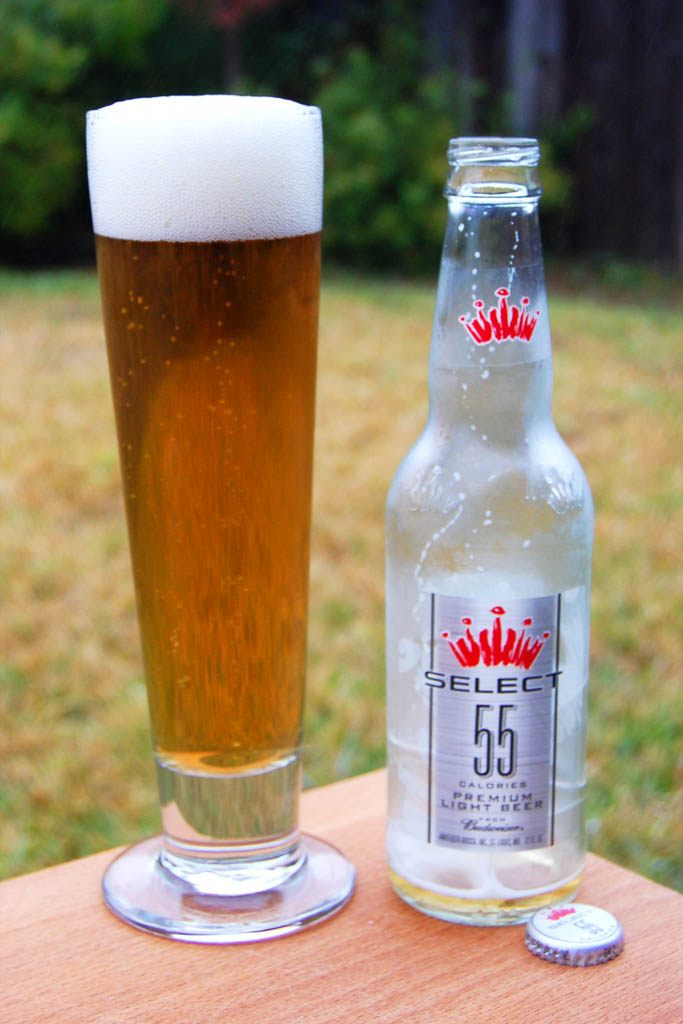
Budweiser Select 55 Review

Brewery: Anheuser-Busch, Inc. | Beer: Budweiser Select 55
Style: American Adjunct Light Lager | ABV: 2.4% | IBUs: ~7
Serving Method: 12 oz. bottle poured into Pilsener glass

The lightest beer in the world. Oh, boy.

In what appears to be the last stop in the race to the bottom that is the low-calorie beer war, Bud Select 55 has reigned supreme as the lightest beer in the world since its introduction back in 2009. It clocks in at 55 calories (duh) and 1.9 grams of carbs. Pretty sure I've had water more fattening than that on occasion.

AB doesn't provide any information on the ingredient bill besides mentioning "caramel malts and a blend of imported and domestic hopping." Here's how they describe the profile:
Select 55 has a light golden color and offers aroma notes of toasted malt and subtle hopping.
I'm trying my best not to be condescending here (I swear). I suppose these types of beer serve a purpose. I must keep an open mind.

Alright, let's pop the top on this lightweight and see what it's like to drink a beer with the caloric content of three Cheetos and a stick of gum.

Appearance: A perfectly clear golden-straw body capped by about a finger of white head that fizzles out quickly and leaves just a hint of sudsy lacing.

Aroma: A faint and watery mix of sweet grains and a hint of grassy hops.

Taste: A twangy and sweetish rice body accompanied by some weak, almost-implied grassy bitterness. A crisp, clean, and damn-near flavorless aftertaste. Have you ever had Bud Light? How about water? Mix ‘em up and this is pretty much what you get.

Mouthfeel: Light bodied with sharp carbonation.

Drinkability: Besides the fact that it’s bland, industrial beer-water this is a highly drinkable summbitch.

Verdict: If you want a buzz without too many calories, Bud Light already exists. If you don’t like the taste of beer, there are plenty of alternatives out there. If you want to cut the flavor, calorie count, and alcohol content off a Bud Light in half, potable tap water is available in almost all American households. So why the hell does this exist?

Grade: D-

Friday, March 6, 2009

The Session 25: Love Lager, A Meditation On The American Adjunct Light Lager

The Session is a monthly project where a bunch of beer bloggers all blog about the same topic. You can read more about the project here. This is PintLog's first time contributing to the project. This month's host is John Duffy (A.K.A. The Beer Nut), and the topic he has chosen is Love Lager, a meditation on the style that most people associate with the word beer.

When thinking about the typical American Lager, three brands immediately spring to mind: Budweiser, Miller, and Coors (collectively known in some beer circles as BMC). These brands account for the majority of American beer produced each year. Differentiated more by marketing than any tangible product attributes, each brews their own version of the American Adjunct Lager.

Designed with the lowest common denominator in mind, the style is light-bodied, pale yellow in color, fizzy, and lacking in any strong hop or malt flavors. Due to the expense of brewing all-malt beers, and the fact that their customer's palates allow them to, adjunct cereal grains (mostly corn and rice) are used to reduce the amount of malted barley required.*

As if the typical American Adjunct Lager wasn't bland enough already, most Americans actually prefer to buy the "light" version of the style. Made popular by Miller in the 70s with Miller Lite, the Light American Adjunct Light Lager is lower in calories, carbohydrates, and (typically) alcohol content. Unfortunately, they're also lighter in flavor.

So the question to be asked is do these beers offer anything but a cheap and quick way to get drunk? To help answer that question, I decided to do my best to objectively review the three best selling American Adjunct Light Lagers: Bud Light, Miller Lite, and Coors Light (they're also three of the four best selling beers in America regardless of style). And just to keep things interesting, I also reviewed the light version of a local favorite: Lone Star, known as the "National Beer of Texas." We Texans are a funny bunch.


I decided to do this the right way, so I headed across the street to the gas station to pick up my review material. Lone Star Light was only available in six-packs, and ran me around $3.50. That's quite possibly the cheapest six-pack I've ever bought. All three nationwide beers were available in handy 24 ounce tall boy cans, for around two dollars. As a bonus, all three were wrapped by the cashier in individual brown paper bags. Let's unwrap these bad boys and dig in.

Bud LightFirst up, Bud Light, the big boy on the block and the best selling beer in the world (according to Anheuser-Busch). "Drinkability" is the latest Bud Light campaign, and seems to be based on the idea that you don't want pesky things like flavor to get in the way of your drinking. With a fuller mouthfeel than usual for this style and a relatively pronounced (if still grainy) body, Bud Light is not the "most drinkable" here. Which is certainly not a bad thing. You can read my full Bud Light review here.

Next, the beer that started it all, Miller Lite. Now the third best selling beer in America (behind Bud Light and Budweiser), Miller Lite positions itself as the light beer that's just too light for a "GH" in the name. Seriously. A new, unintentionally hilarious, campaign touts the beer as a great way to "Get Hip to the Hops." The beer itself is the same fizzy, yellow stuff as the others, but plagued with a nasty chemical taste. You can read my full Miller Lite review here.

Number four on the American sales charts is Coors Light, the "Silver Bullet." Coors markets the beer almost exclusively around the concept of coldness, which I suppose is rather telling. Without a doubt the most gimmicky delivery device here, its can has a vented mouth, a "Frost Brew Liner," and a "Cold Activated" mountain scene on the side. The beer itself has a better flavor profile than most beers in this style, but almost no nose whatsoever. You can read my full Coors Light review here.

In order to keep things a bit interesting, I felt compelled to add a local favorite. Here in Texas, Lone Star is the local Lager for most people. Because it wouldn't be fair to compare three light Lagers to a regular Lager, I've opted for Lone Star Light, a beer that I'd never actually tried before now. Unfortunately, it's just as bland and soulless as the national fare. On the plus side, it does have some awesome pictogram puzzles under the bottlecap. You can read my full Lone Star Light review here.

So, after tasting them all, how do they rank?
  • In fourth place, Miller Lite - the chemical taste just killed it.
  • In third place, Lone Star Light - much blander than the "National Beer of Texas" should be.
  • In second place, Bud Light - a fuller body than the previous two beers, but just too grainy to win.
  • And our winner today, a total surprise to me, is Coors Light - hardly a full-flavored beer, but the best taste profile of the group.
So, after my best attempt at objectively reviewing the three big American Adjunct Light Lagers and a local wildcard, has my low opinion changed? Not at all. Viewed alone in a vacuum these beers are not necessarily bad (aside from an occasional chemical taste); but when compared to the rest of the beer world, they're just not good. They don't taste like horse piss or even cat piss. If I'm offered one of these beers at a party, am I going turn up my nose and refuse, citing the superiority of craft-brewed beer? Of course not.

Remember, just because someone likes these beers, that doesn't make them some sort uncultured philistine. Think how much money they're saving over saps like me!

*Reader Mike, who clearly know a lot more about brewing than me, wrote in to dispute the assertion that brewing with adjuncts is cheaper than with all-malt. Here's how Mike puts it:
Adjuncts used in adjunct lager brewing are not significantly cheaper than barley malt. They were historically used to lower the protein content and astringency of North American 6 row barley prior to the successful Canadian 2 row barley breeding programs of the 70's and 80's for growing dry land barley. Low cost factored into their use more in the past more than today, but an all malt beer before the successful breeding of North American 2 row malt was astringent and tended to be hazy at low serving temperatures. Their use now is about light flavour. Brewing with corn and rice increases energy use and brewhouse cycle times. In the case of high maltose corn syrup cycle times reduce and plant efficiency goes up. This comes at a cost. Corn syrup is generally more expensive than malt lately.

All malt is used in craft circles because it is actually cheaper and markets better due to the difference. The plant required for using adjuncts is usually prohibitive and is more complicated to use.
Many thanks to Mike for the info.

Bud Light Review

Brewery: Anheuser-Busch, Inc. | Beer: Bud Light
Style: American Adjunct Light Lager | ABV: 4.2%
Serving Method: 24 oz. can poured into Pilsener glass

Bud LightThis review is a part of an article on the American Adjunct Light Lager as part of the monthly beer blogging project The Session.

Introduced as Anheuser-Busch's answer to the popular Miller Lite (and to a lesser degree, Coors Light) in 1982, Bud Light has become the best selling beer in the world (according to AB). As with it's fellow Light Lagers, the product is differentiated and made successful mostly by it's marketing. Bud Light has been pitched with some truly brilliant ads including "Swear Jar" and the "Real Men of Genius " radio series.

Their latest campaign centers on one of Bud Light's core product attributes, "The Difference Is Drinkability." The message, apparently, is that you don't want anything like flavor getting in the way of drinking as much beer as possible. I suppose if that's what you're drinking for, Bud Light isn't a bad choice.

As for the beer itself, it's your typical American Adjunct Light Lager; a low-calorie, light-bodied beer with an "inoffensive" flavor profile. Here's how AB describe the ingredients:

Bud Light is made with a blend of two and six-row malt and cereal grains for a clean and crisp, smooth taste. In addition, it is brewed with all-natural ingredients - water, barley malt, rice, hops and yeast.
Mmm, nothing like an ice-cold rice beer to unwind with after a hard day.

Appearance: The standard crystal-clear, pale straw-yellow body with a fizzy white head that recedes rapidly.

Aroma: Sweet and grainy with a somewhat fuller body than you usually get in this style (still firmly in the thin territory). In place of hops, a handful of crisp fruitiness.

Taste: A thin, grainy malt body with the barest hints of hops, but no bitterness to speak of. Compared to other American macro light beers, Bud Light has perhaps a little fuller flavor profile and is not as plagued with skunkiness.

Mouthfeel: A little fuller than average, but still very thin compared to most beer. Fizzy with a dry finish.

Drinkability: The usual Light Lager Catch-22; it goes down easily but there's not much desire to keep going.

Verdict: This tastes like college to me. A somewhat fuller body and more pronounced flavor profile than many in this style, but still amazingly bland and shallow. If faced with a choice between a Bud Light, Miller Lite, or Coors Light I suppose this is would be my second choice.

Grade: D

Miller Lite Review

Brewery: Miller Brewing Co. | Beer: Miller Lite
Style: American Adjunct Light Lager | ABV: 4.2%
Serving Method: 24 oz. can poured into
Pilsener glass

This review is a part of an article on the American Adjunct Light Lager as part of the monthly beer blogging project The Session.

Developed back in 1967, the beer we know as Miller Lite started life as Gablinger's Diet Beer, the first light beer. Meister Brau acquired the recipe a few years later, and the beer was renamed Meister Brau Lite. Once Miller bought out Meister Brau in the mid-seventies, the recipe was tweaked and the beer was re-renamed Miller Lite.

Under Miller's management and with their superior marketing muscle, sales of the beer finally took off. Miller Lite was essentially the first to market in the light beer segment, and held the sales lead until 1994, when Bud Light became the top dog. The light beer category itself tipped in 1992, becoming the biggest selling segment of the American beer landscape.

Miller Lite has enjoyed many hit marketing campaigns, including the legendary "Great Tasting, Less Filling," "Man Laws," and the controversial "Catfight." Miller Lite's latest campaign touts the benefits of the the beer's flavor profile, "Get Hip to the Hops." Check out the Miller Lite website for some unintentionally hilarious video clips about the awesome power of the "triple hops brewing processes."

Marketing campaign's aside, let's peel back the brown paper bag and see what's inside.

Appearance: Pale straw-yellow, crystal-clear body with a fizzy bright-white head that recedes quickly and leaves no lacing.

Aroma: Crisp and cidery with a plain, grainy sweetness. There's definitely something funky going on here.

Taste: Very thin flavor profile. Thin, grainy malt with hardly any bitterness from the hops, just some crispness and a bit of fruitiness. Unfortunately, there's a nasty chemical taste lurking around the edges, waiting to grab you. Thin, grainy aftertaste.

Mouthfeel: Watery and fizzy, the standard for this style.

Drinkability: On occasion I've been forced to test the drinkability of this beer, and it keeps going down easy for quite a while. But unless you're looking to get drunk, there's no point.

Verdict: Maybe I'm just not "hip to the hops," but this sucks. It's the normal thin and bland profile you'd expect from this style, but with a nasty chemical taste takes it to a new level of shitiness. Firmly behind both Bud Light and Coors Light.

Grade: F

Coors Light Review

Brewery: Coors Brewing Co. | Beer: Coors Light
Style: American Adjunct Light Lager | ABV: 4.2%
Serving Method: 24 oz. can poured into Pilsener glass

This review is a part of an article on the American Adjunct Light Lager as part of the monthly beer blogging project The Session.

Introduced in 1978, Coors Light is the beer that really put the Colorado-based Coors Brewing Company on the map, and is by far their biggest seller. "The Silver Bullet's" brand image is all about the concept of Coors Light as the coldest beer. From the "frost brewing" process, to the ice-covered train featured in the commercials, and the fact that the beer is shipped across country in constant refrigeration; it's all about low temperatures.

Coors has plenty of gimmicks to go along with the marketing talking points. Besides a vented mouth for speed, this can is equipped with both the "Frost Brew Liner" and the "Cold Activated" mountains. According to the can, the blue liner "locks in good taste," while the mountains will turn blue "at the peak of cold refreshment." Here I was thinking it was just an aluminum can.

All of this has sparked a belief in many people that somehow Coors is a mystical, delicate beer, and must be kept cold at all times. They think if it is allowed to warm at all, its ruined. The power of marketing is strong, especially when it comes to light beers.

Well, the mountains just turned blue, so let's dive in.

Appearance: A pale golden body with a white head that recedes at a rate I've never seen, it destroys itself in mere seconds.

Aroma: Thinner than thin, with only the barest whiff of grain. Blink and you miss it.

Taste: Much fuller than the aroma would suggest, but still a very thin flavor profile. A sweet and grainy base with a little more "hop" flavor than most in this style. Bland, but better than many light lagers.

Mouthfeel: As you would expect, light-bodied and fizzy with a dry finish.

Drinkability: The only thing holding you back is the boring flavor profile.

Verdict: Another very boring Light Lager, but quite probably the one I'd reach for from a cooler stocked with only Bud Light, Miller Lite, and Coors Light. It's not as skunky as Miller Lite and just a little bit better tasting than Bud Light.

Grade: D

Lone Star Light Review

Brewery: Pabst Brewing Co. | Beer: Lone Star Light
Style: American Adjunct Light Lager | ABV: 3.9%
Serving Method: 12 oz. bottle poured into
Pilsener glass

This review is part of an article on the American Adjunct Light Lager as part of the monthly beer blogging project The Session.

I'm a resident of the great state of Texas. I know to many people who read that statement, a lot of negative stereotypes come to mind, but Texas is much more complex than you might think. While I'm certainly not your typical Texan, I've found much to love about my state. Not least of these is great local beer, something that most people probably don't associate with the Lone Star State.

Unfortunately, not all beer brewed in Texas is top-shelf. Lone Star, a brand owned by the Pabst Brewing Company, pitches itself as "The National Beer of Texas." They make only two products: Lone Star (an American Adjunct Lager) and Lone Star Light (an American Adjunct Light Lager). According to Lone Star, for "maximum flavor and zest," the light version retains "the level of hopping and carbonation found in the full-calorie version." Thank God for that. Lone Star Light took home a silver medal for American-Style Light Lager at the 2008 World Beer Cup.

Here's the great thing about Lone Star beers, and why I always pick them out of the cooler at a party before a Bud/Miller/Coors: bottle-cap puzzles. Every Lone Star bottle-cap has a little pictogram puzzle printed on the underside. Some are simple, some are somewhat of a stretch, but they're always fun. In the bland American Adjunct Light Lager world, a little puzzle can make all the difference.

Appearance: Paler than pale yellow, crystal-clear and fizzy with a white head that recedes rapidly and leaves no lacing to speak of. In a bizarre twist, it looks a lot like champagne.

Aroma: Thin, sweet hints of "malt"with no real hops to speak of, just some crisp apple.

Taste: The body is composed of a thin, sweet, rather corny (no pun intended) twang; the same crap you're used to from this style. Hardly any bitterness whatsoever, just more of the apple.

Mouthfeel: Thin, watery, and fizzy. Simple as that.

Drinkability: Think of the drinkability of water, then imagine one notch less drinkable than that. The only thing holding you back is the bland taste.

Verdict: Essential indistinguishable from the national brands, Texas certainly deserves a better "National beer" than this. Luckily, the Lone Star State is home to a whole slate of brilliant breweries, including Saint Arnold, Independence, Spoetzl (makers of Shiner beers), & Rahr. At least Lone Star has the awesome puzzles...

Grade: D-